
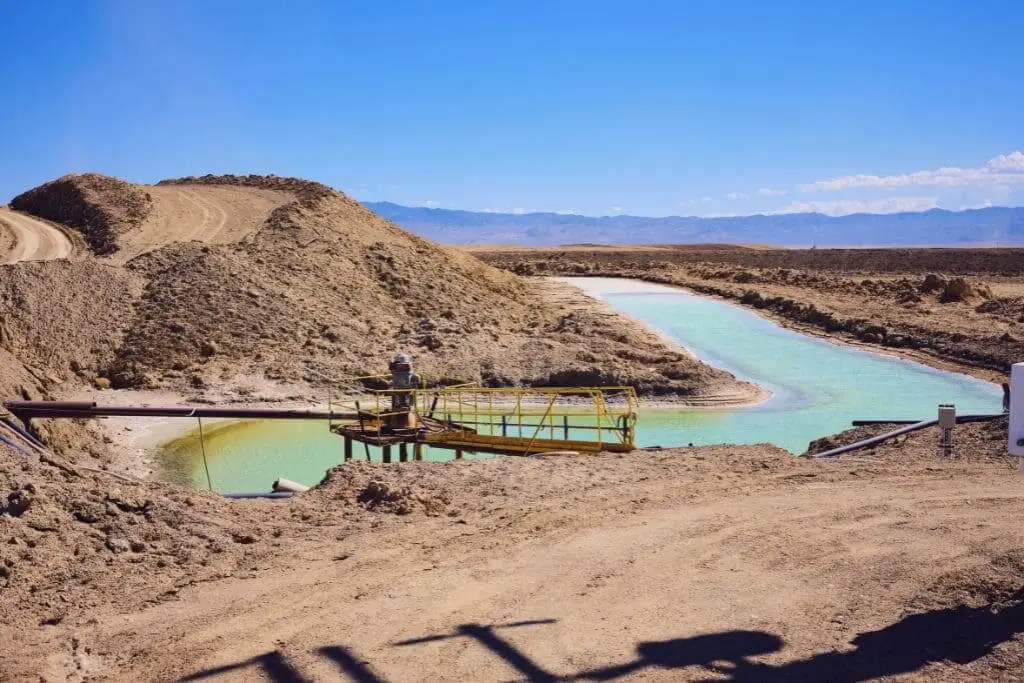
Today we are going to see the impact of batteries in terms of CO2 emissions
In this article, we will only focus on the carbon footprint (CO2 equivalent emissions) of batteries. It is important to keep in mind that the environmental impact goes beyond greenhouse gas emissions, with direct impacts on biodiversity, soil pollution, water consumption, etc. (source: Carbone 4 FAQ on Electric Vehicles).
Part 1: Future European Regulation
The European metallurgical industry, particularly the battery metals industry, heavily relies on imports. However, the recent European regulation on Critical Raw Materials aims to reverse this trend. Establishing European sovereignty in the battery sector is crucial for controlling greenhouse gas emissions and supporting the transition to electric mobility. Several initiatives are underway in the Li-ion battery value chain, including the opening of large lithium mines by Imerys in France and Infinity Lithium in Spain, the development of three gigafactories in France by Verkor, ACC, and Envision AESC for Li-ion battery cell production, and the European Commission's investment in the ReLieVe recycling project.
In December 2022, the European Council and Parliament reached a preliminary agreement on a proposal for the regulation of batteries and used batteries, aiming to ensure the sustainability and competitiveness of the EU's battery value chains. This regulation establishes rules for calculating the carbon footprint of batteries, their recycling efficiency, and minimum targets for the recovery of cobalt, lead, lithium, and nickel.
One of the main objectives of this regulation is to introduce a battery passport, which will provide information on the sustainability requirements of batteries. A QR code on the battery will grant access to information about manufacturing, carbon footprint, recycled content, and expected lifespan. The ultimate goal of the battery passport is to ensure that batteries introduced to the European market do not exceed a certain manufacturing emissions threshold.
.webp)
Part 2: Methods for Calculating the Carbon Footprint of Batteries
The overall carbon footprint of a Li-ion battery is complex as it involves numerous materials that are extracted and processed into high-quality metals for batteries, including lithium, nickel, manganese, cobalt, and graphite. It also involves assembly processes and depends heavily on the methods, producers, and energy used by them (such as natural gas, carbon-intensive electricity, etc.).
Therefore, there are significant variations compared to existing average values. The data and calculation methods need better regulation to assess the actual differences in carbon footprints between different types of batteries accurately.
Lithium-ion (Li-ion) batteries are reusable energy storage devices composed of various materials, and their manufacturing involves two major phases: raw material production (including extraction and processing) and the battery assembly process (including component manufacturing).
1. Carbon Footprint of Raw Material Production
- The most common method for lithium production is highly energy-intensive, requiring between 15 and 17 kWh per ton of processed material. Other less common methods can be up to five times less CO2-emitting. Therefore, lithium production has a significant carbon footprint. Considering direct and indirect emissions from a Chilean producer (scopes 1, 2, and 3), the carbon footprint reaches 6.6 kgCO2e/kg LCE (lithium carbonate equivalent).

- Nickel, used in the form of nickel sulfate, is produced through various hydrometallurgical methods. Some processes are more environmentally friendly, while others are more energy-intensive and polluting. Carbon footprint can be multiplied by 4 between different methods.
- Manganese, used in the form of manganese sulfate, can be produced from carbonate ore or pyrolusite, both involving processes like crushing, heating, drying, adding sulfuric acid, purification, etc.
- Cobalt is mainly produced in the Copperbelt region of the Democratic Republic of Congo and Zambia as a byproduct of copper, nickel, and lead extraction. Information on the carbon footprint of cobalt is limited.
- Graphite is used in batteries in its natural or synthetic form, with synthetic graphite offering higher energy density and longer lifespan. However, the carbon footprint of graphite production is often underestimated.
Graphite and nickel are the two main greenhouse gas (GHG) emitting resources during their production (as shown in the graph below).
Beyond the carbon footprint, these resources are limited and rare. Their exploitation must be controlled, and every gram of rare mineral should be reused or recycled at the end of life.
2. Carbon Footprint of Battery Assembly
Here's a brief overview of battery composition: What are Batteries.
The battery assembly process involves several stages :
- Production of electrodes : The active materials of each electrode are reduced to powder, which is then mixed with other chemicals to form the electrode. The electrodes are then dried at high temperatures.
- Preparation of electrolyte : Lithium salts are added to a solvent to form the electrolyte. The solution is placed in the battery to allow ions to move between the electrodes.
- Cell assembly : Assembly of electrodes and electrolyte in a metal casing.
- charging : The battery is charged to force lithium ions to move from the cathode to the anode.
- Final assembly : Multiple cells are combined to create a pack.
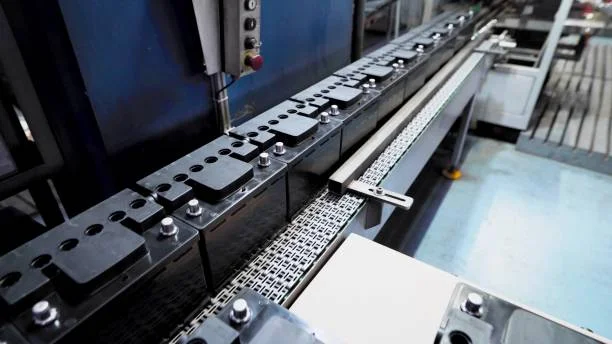
One of the most energy-intensive steps is the drying process, which represents nearly 50% of the energy consumption in the assembly process. The GHG emissions during assembly largely depend on the energy source used for drying. Since the majority of batteries are assembled in China, the energy mix used is primarily coal-based, which is carbon-intensive.
Part 3: Final Carbon Footprint of a Battery
.webp)
The Carbone 4 study shows that the majority of the carbon footprint of Li-ion batteries, about 80%, is attributed to material production rather than assembly or use.
The difference in carbon footprint throughout the life cycle of a battery can reach up to 60% between a battery containing high-carbon-intensity materials and one containing lower-carbon-intensity materials. This difference is mainly due to the nature of extracted natural materials and the impact of upstream material production methods (+70% CO2). Assembly methods (+70% CO2) also contribute significantly. Among the upstream materials, graphite (x30) and nickel (x3) show the most significant differences in terms of carbon intensity.
Therefore, the final carbon footprint of a Li-ion battery varies from 77 to 221 kg CO2e/kWh.
These results highlight that battery production accounts for a significant, if not the majority, portion of the carbon footprint of an electric vehicle.
Here's an example of the carbon footprint associated with the manufacturing of an electric city car (52 kWh battery with NMC 811 chemistry):
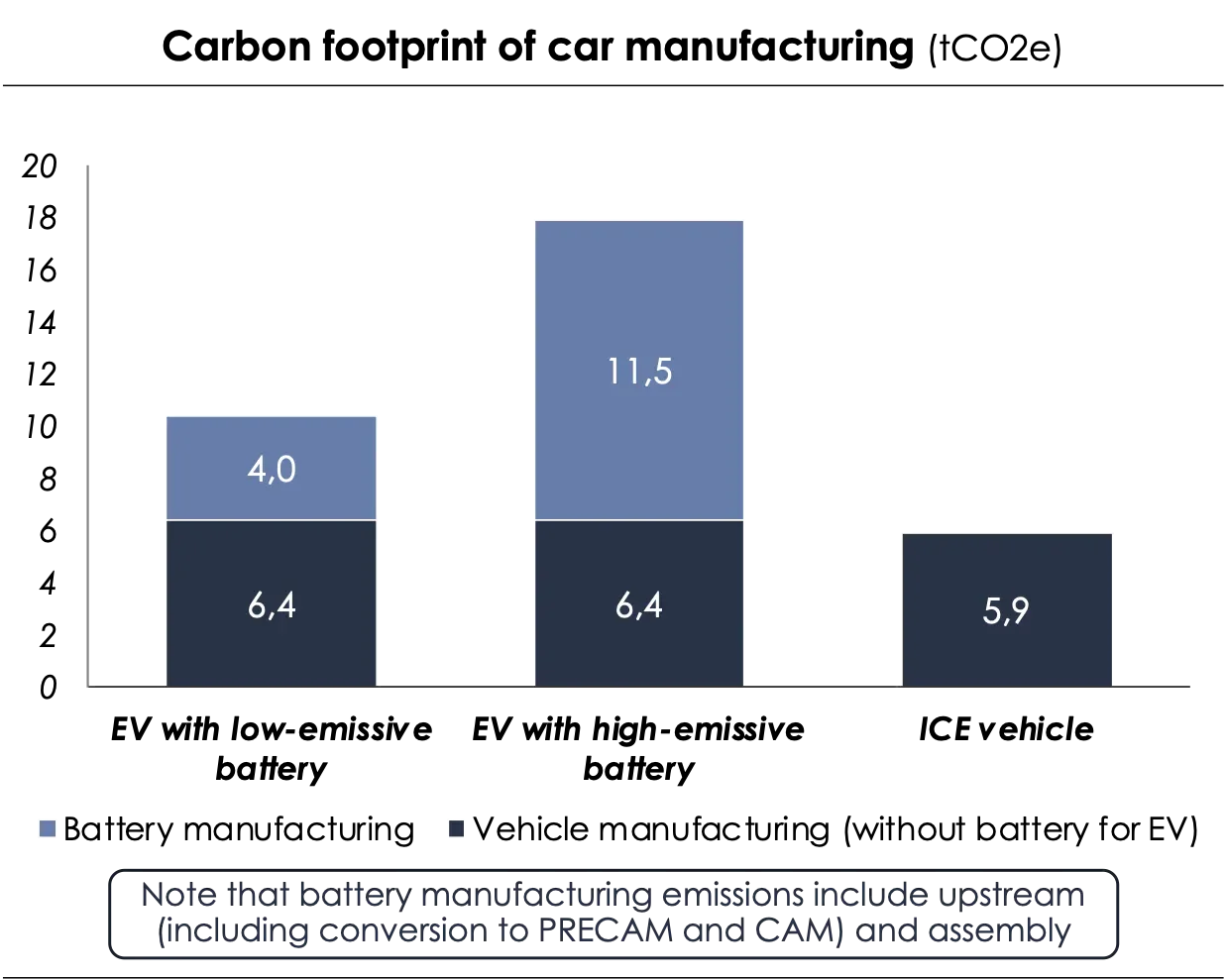
Battery production is thus a significant source of CO2 emissions and consumption of rare resources in the field of mobility. It is essential to extend their lifespan by promoting circular economy practices such as repair, reuse, and recycling, as advocated by Bib Batteries.
Sources
https://www.carbone4.com/publication-liion-battery-carbon-footprint
Explore our resources

Stay informed about Bib's latest updates
Get technical content, use cases, and industry updates — tailored to your needs.
Want to know more?
Get in touch for more detailed information.