
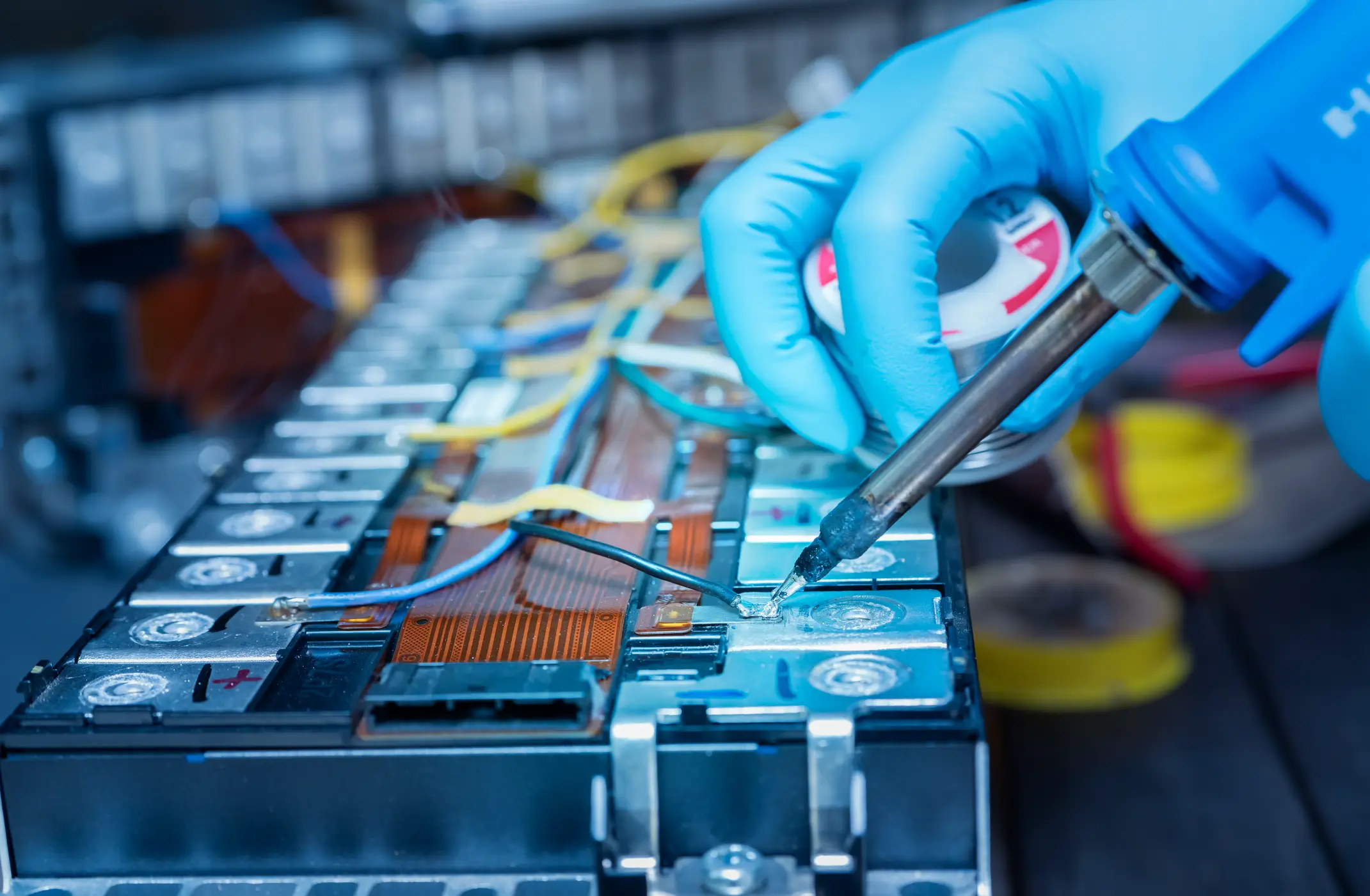
What is the mechanism behind degradation?
When a battery is in use, lithium ions move between electrodes via the electrolyte. For an electrical charge to be stored, these ions must form bonds with the electrodes. This process is called intercalation, and the chemical and physical structures of the electrodes are modified.
.webp)
Each time an ion enters or leaves the electrode, the latter undergoes expansion and contraction, in a heterogeneous way. Micro- and macroscopic defects accumulate in the electrodes, reducing ionic conductivity and increasing resistance.
Degradation can also be chemical: reactions form by-products that affect the way the cell works. The cathode can also dissolve in the electrolyte, which degrades as the reactions take place.
These mechanisms occur with each cycle, but some factors will accelerate them:
- Operation with a heavily charged or discharged cell
- Deep discharge cycles : the deeper the cycle, the greater the degradation
- Voltage maintained above or below the nominal value for an extended period of time
- Extremely high or low temperatures
- Humidity presence.
.webp)
What are the effects of degradation?
One might think that the internal state of a battery doesn't matter, as long as it's working. But using a degraded battery can have adverse effects.
Reduced capacity
A battery's capacity is reduced as it deteriorates: it has to be recharged more frequently for the same use.
If you use batteries for commercial purposes, this will have two main consequences :
- The charging time increases, mechanically reducing the periods when the battery is operational;
- Your electricity and logistics costs increase because you have to recharge the batteries more often.
.webp)
Increased internal resistance
Current does not flow through a battery without resistance: the electrodes, electrolyte and all the other circuits and accessories form an impedance to the current, which increases as the battery deteriorates.
Too much resistance is harmful for several reasons:
- Heat generation : the more advanced the degradation, the greater the heat generated, and the more the battery will degrade. This heat generation is dangerous and damaged batteries that heat up need to be stored in special conditions
- Reduced efficiency : das energy is lost in the form of heat, more electricity will be consumed during use and recharging
- Weakened voltage : esistance reduces the voltage at the cell terminals; if the voltage becomes too low, the performance of some equipment may deteriorate.
--
In short, using a degraded battery is increasingly expensive, difficult and dangerous, even if it remains technically possible.
To see what can happen to a battery that can no longer be used for its original purpose, you can read our article How to deal with a malfunctiong battery and contact us at contact@bib-batteries.fr !
Explore our resources


Stay informed about Bib's latest updates
Get technical content, use cases, and industry updates — tailored to your needs.
Want to know more?
Get in touch for more detailed information.